
Tiling quote template
A practical scope checklist for tilers and their customersA useful tiling quote does more than put a price beside a room size. It explains which surfaces are included, who supplies each material, what preparation is allowed for and what will happen if the job changes. Use the outline below to organise your own proposal and help the customer compare like with like.
This is an editable structure to copy into your own document, not a downloadable file, legal contract or recommendation of a universal rate. Confirm the actual site conditions and your business terms before issuing a quotation.
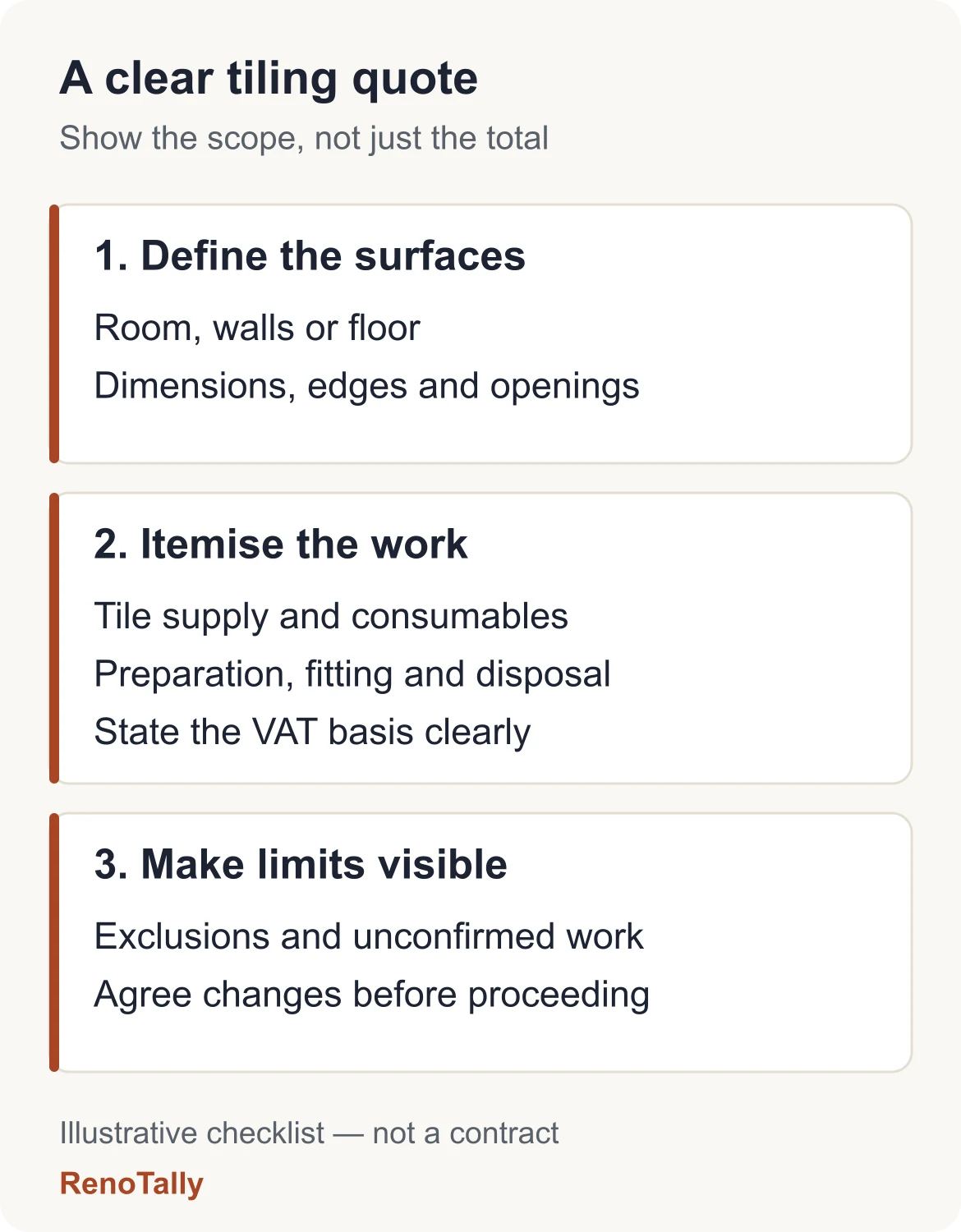
Define the surfaces
Record the measured areas and agree exactly which surfaces are included.
Itemise the work
Separate tile supply, preparation, consumables and fitting in the quote.
Make limits visible
State exclusions, payment terms and how changes will be agreed.
In this guide
A tiling quote outline you can copy
Replace each prompt with the details of the actual job. Do not leave assumptions hidden inside a single total.
- Quote reference and date: [your reference; date prepared]
- Prepared by and for: [business details; customer; project address]
- Surfaces included: [room; wall or floor; dimensions; measured area; boundaries]
- Tile specification and supply: [product; format; pattern; supplier; who orders]
- Preparation allowed for: [inspection; removal; substrate work; agreed limits]
- Materials and consumables: [tile supply; adhesive; grout; trims; other specified items]
- Fitting and finishing: [labour scope; layout; edges; cuts; finishing tasks]
- Access and programme: [working access; protection; sequence; planned dates]
- Excluded or unconfirmed items: [explicit list; information still needed]
- Price breakdown: [item; quantity or pricing basis; amount; VAT treatment]
- Total and payment arrangements: [agreed total; timing; applicable business terms]
- Changes and acceptance: [how scope changes are agreed; customer acceptance process]
Keep customer information in your own secure quotation workflow. This page does not ask you to send it to RenoTally.
Start with the surfaces, not just the room name
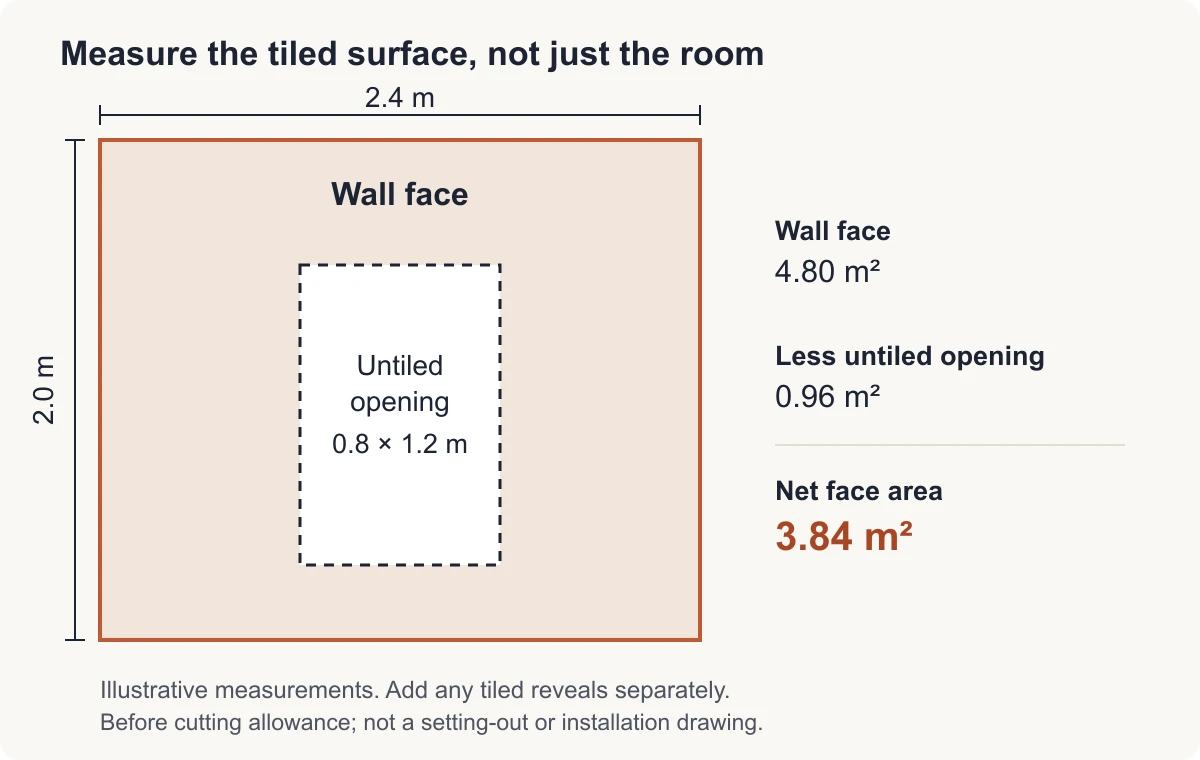
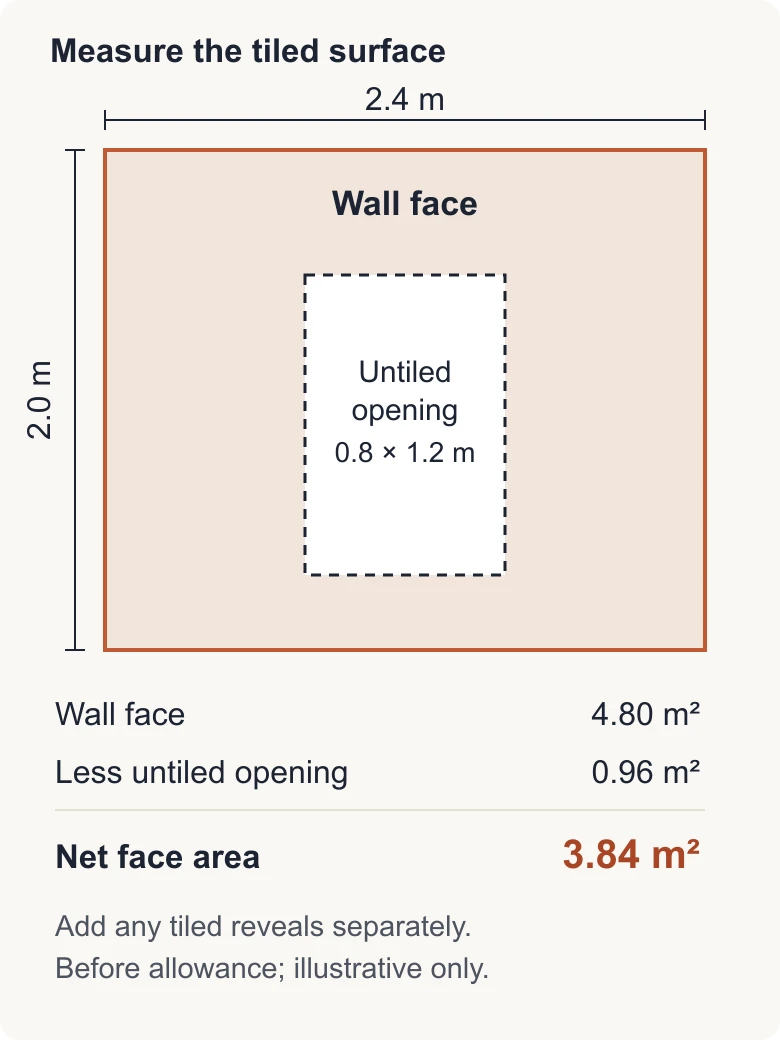
A bathroom quote can mean a floor, a splashback, selected walls or every tiled surface. Identify each one separately and describe where tiling begins and ends. Record any openings, niches, returns and boxing that affect the work rather than assuming they are included in the room label.
Distinguish the measured surface from the material order. Cutting allowance and whole-box rounding may increase the quantity bought; they do not automatically increase the area being fitted. State the pricing basis you have used so that the customer can follow the calculation.
See our guide to measuring tile quantities and ordering whole boxes
Confirm the tile specification and who supplies it
Record the tile product or an agreed allowance, its format, the intended pattern and the finish required at edges. If the customer is still choosing a tile, say which part of the proposal remains subject to that choice. Do not silently price one product while the customer expects another.
State who measures for ordering, buys the tiles, checks deliveries and arranges replacements. When the customer supplies materials, identify what you need on site and when. Confirm the selected product and installation requirements with the relevant supplier or manufacturer; a generic planning checklist cannot establish compatibility.
Make preparation and consumables visible
A headline fitting price can hide very different scopes. Say whether your proposal includes removing the old finish, disposing of waste, preparing the surface and protecting adjacent areas. List the work you have actually assessed, and separate anything that cannot be confirmed until the existing finish is removed.
Identify adhesive, grout, trims and other specified consumables separately from the tiles. Where waterproofing, movement details or substrate repairs are relevant, record who is responsible for assessing and specifying them. Do not use this checklist as a substitute for the appropriate product instructions or a site assessment.
Separate the price into understandable items
Use the breakdown that matches your actual offer. Materials, preparation, fitting and waste removal are useful headings, but do not force every job into the same unit rate. State whether each line is a fixed amount, a quantity multiplied by a rate or an allowance still to be confirmed.
Make the VAT basis clear and consistent with your business circumstances. Do not copy a competitor's rates or treat a calculator result as your own binding quotation. The commercial price must reflect the job you have assessed.
Illustrative quote structure — no market rates or total implied
- Tile supply: Agreed product and whole-box order, or clearly excluded as customer-supplied
- Preparation: Only the assessed tasks and agreed limits
- Fitting: Specified surfaces, format, pattern and finishing scope
- Consumables: Named inclusions rather than an assumed bundle
- Removal and disposal: Included tasks or an explicit exclusion
- Unconfirmed work: What needs investigation and agreement before pricing
Use a quantity estimate without confusing it with the job price
Our tile calculator can help you work through an area-based tile quantity and a material-cost allowance. It does not produce a complete installed-price quotation. Keep labour, preparation, adhesives, grout, trims, removal and other job-specific items separate.
Check the actual product's pack coverage and ordering rules before buying. An estimate of individual tiles is not automatically a whole-box order. The existing quantity guide shows the extra rounding step and explains the tool's limitations.
Read our UK tiling cost and quote-scope guide
Record access, timing and changes before work starts
Explain the access needed, any protection arrangements and how your work fits around other trades. Distinguish a planned start or duration from dates that have actually been agreed. Identify dependencies such as materials being available and preparatory work being complete.
Set out how a change will be recorded and priced. A different tile, extra surface or newly discovered preparation requirement should not disappear into an unexplained final bill. Confirm the revised scope, price and timing with the customer through your normal written process.
For homeowners: compare the scope before comparing the total
Put the proposals side by side and check whether they describe the same surfaces and specification. One may include tile supply and disposal while another covers fitting only. Ask about missing items rather than assuming the lowest total includes everything.
Useful questions include: who buys the tiles; what preparation has been allowed for; whether consumables are included; what remains unconfirmed; and how any extra work would be agreed. Keep the answers with the proposal you accept.
Planning and presenting your tiling work
Keep a clear record of the specification, customer decisions and the final scope alongside your estimate. RenoTally's flooring and tiling area brings together relevant planning tools and guidance; the contractor membership page explains the current offer separately.
Explore our flooring and tiling planning resources
See how RenoTally contractor membership works
Sources and methodology
This guide provides an organisational checklist, not a market-price survey, technical installation specification or legal template. No competitor prices or credentials are presented as RenoTally data. Calculator assumptions and research references are explained on our central methodology page.