
How many tiles do I need?
Measure, allow for cuts and check whole boxesTurn your measurements into a practical tile order. Work out the tiled area, choose a cutting allowance and check how many whole boxes to buy.
An area-based planning guide, not a fitting quote or an exact cutting plan.
Measure the area
Measure each wall or floor. Order different tile products separately.
Allow for cuts
Agree an allowance for your chosen tile, pattern and room. Do not add it twice.
Check whole boxes
Use the product’s pack label and round up if it is sold only in full boxes.
A tile count is not yet a box order
Our worked example estimates 198 tiles. With an assumed 15 tiles per box, the separate purchase check is 14 whole boxes: 210 tiles.
Illustrative pack size only. Check the label of the product you intend to buy.
In this guide
To plan a tile order, start with the surfaces you actually want to cover, not just the room's floor area. Measure each surface, choose a cutting allowance for your layout, then check how your chosen tiles are sold.
Our tile calculator gives an area-based piece estimate and tile-material allowance. This guide explains the measurements behind that result and the extra box-rounding step to complete before you buy. It is not a fitting quote or an exact cutting plan.
Measure each surface separately
For a rectangular floor, record the length and width in metres. For a wall, use its width and the height you intend to tile. A partly tiled wall needs the planned tiled height, not automatically the full ceiling height.
Break an L-shaped floor into non-overlapping rectangles. For several walls, keep a small list of the individual measurements. Add their areas only when they use the same tile and the same ordering assumptions; keep different tile products separate.
Record untiled doors, windows and other openings separately. Include any reveals or recess surfaces that will be tiled rather than assuming the whole opening can be removed from the calculation. For awkward edges, confirm the drawing with your installer before ordering.
Manual measurement example, not a calculator output
Wall face: 2.4 m × 2.0 m = 4.80 m²
Untiled opening: 0.8 m × 1.2 m = 0.96 m²
Net face before allowance: 4.80 − 0.96 = 3.84 m²
Assumes the opening is fully untiled and excludes reveals. Add any tiled returns separately; do not apply this deduction blindly to a real room.
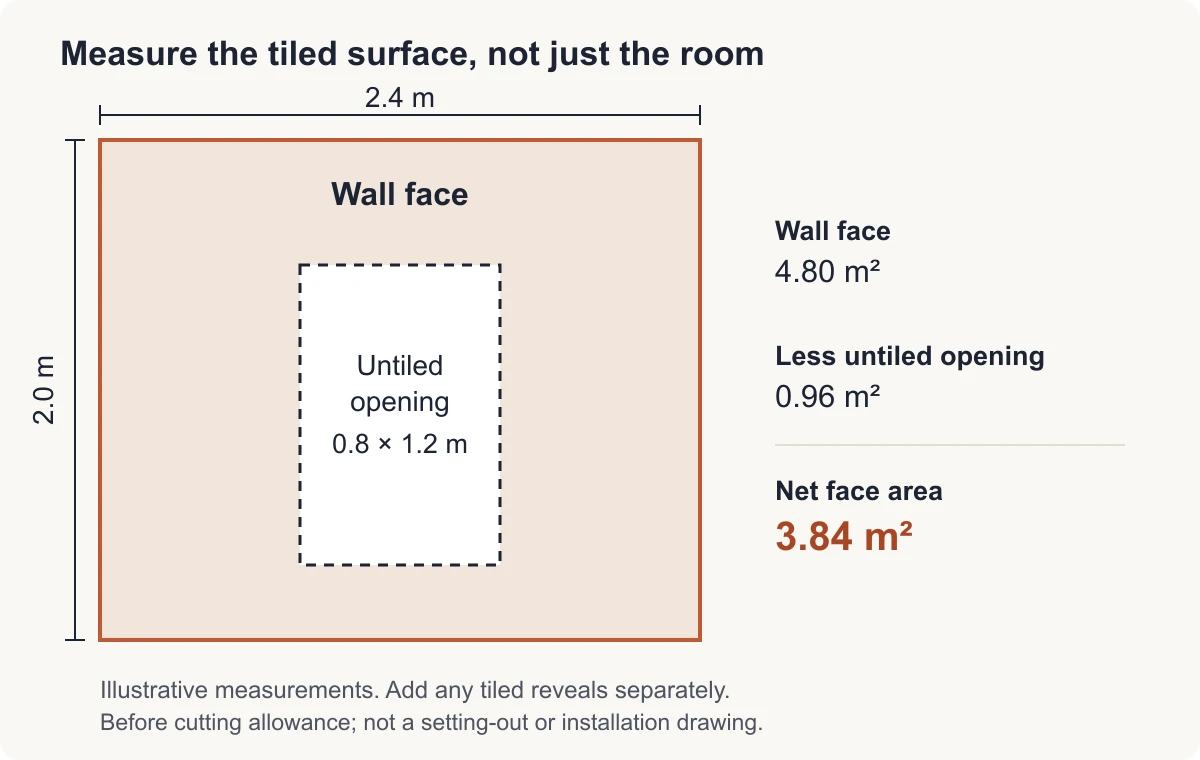
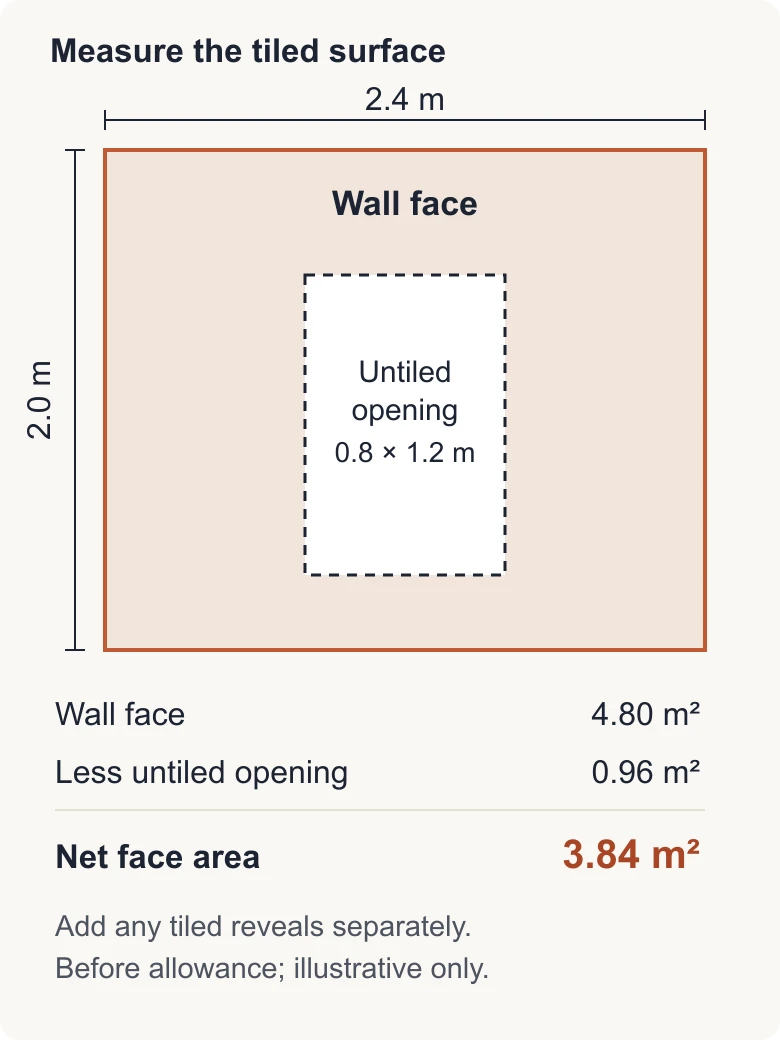
Original measurement diagram. The opening is fully untiled; add any tiled reveals separately. Illustrative only, before cutting allowance.
Keep metres, tile sizes and box coverage separate
The calculator takes the surface dimensions in metres and the tile dimensions in centimetres. A 30 cm × 30 cm tile is 0.30 m × 0.30 m, giving a face area of 0.09 m². Do not enter 300 for a tile measured as 300 mm: that would describe 300 cm in these fields.
A count of individual tiles is different from a box's square-metre coverage. Read the selected product's pack label or supplier specification; do not infer box size from a photograph or from another tile range.
Use the product’s actual ordering and coverage information for the final purchase. Nominal tile dimensions, sheet-mounted mosaics, mixed-size patterns and grout joints can make a simple face-area division an incomplete ordering method.
Choose the cutting allowance for the layout
The Wastage field adds a percentage to the measured area before the quantity is rounded up. Its initial value is an editable assumption, not a promise that it will cover every room.
Show your installer the tile format, room outline and intended pattern. Agree what to allow for edge cuts, awkward corners, breakages and any spare tiles you want to keep. Avoid adding the same allowance twice if the supplier's ordering tool already includes it.
A cutting allowance is extra tile material. It is not the same thing as financial contingency for hidden preparation work. This guide does not prescribe a universal percentage.
A worked example using our tile calculator
This static example uses the current calculator's initial values, checked on 11 October 2026. It describes a hypothetical rectangular surface. The 10% allowance is chosen for the example and £25/m² is an illustrative entered price, not a market average or a supplier offer.
Static planning example — not a quote
Example inputs
- Room length: 4.5 m
- Room width: 3.6 m
- Tile size: 30 cm × 30 cm
- Chosen wastage: 10%
- Hypothetical tile price: £25 per m²
Calculator result
- Area to tile: 16.2 m²
- Tiles needed: 198
- Estimated tile-material cost: £445.50
How the figures work
- 4.5 × 3.6 = 16.2 m²
- 16.2 × 1.10 = 17.82 m² including the chosen allowance
- 0.30 × 0.30 = 0.09 m² per tile
- Round up 17.82 ÷ 0.09 = 198 tiles
- 17.82 × £25 = £445.50
For this example, assume the entered £25/m² includes VAT. The calculator does not add or remove VAT; use a consistent price basis.
The cost uses the allowance-adjusted area, not a full-box order. It excludes fitting, adhesive, grout, trims, preparation, removal, waterproofing and delivery. It does not map individual cuts or grout gaps.
Round the purchase to whole boxes
The calculator does not ask how many tiles are in a box. Complete that step separately, using the actual label for your chosen product.
For a hypothetical label showing 15 tiles and 1.35 m² per box, the 198-tile example needs 198 ÷ 15 = 13.2 boxes. If this product is sold only in full boxes, round up to 14. That gives 210 tiles and 18.90 m² of stated coverage.
At the same hypothetical £25/m², 18.90 m² would be £472.50, rather than the calculator's £445.50. This demonstrates why a material estimate and the amount charged for whole packs can differ. Use the supplier's actual box price, selling unit and VAT basis for your final budget.
These sample label values are not a recommendation for a specific tile. If the packaging differs, or tiles are sold individually, use that product's rules instead.
Check the order before you buy
- Ask the installer to check the measured surfaces, layout and chosen allowance.
- Confirm the product code, format, pieces or coverage per box and whether it is sold in full packs.
- Ask the supplier about matching production batches, shade and any relevant size markings across the order.
- Agree which spare tiles to retain for future repairs; do not assume box rounding supplies enough for every purpose.
- Check delivery charges, damaged-item procedures and the supplier's actual returns terms before paying.
This guide does not promise a returns window, availability of matching future batches or an exact installation quantity.
Plan the installation budget separately
Buying enough tiles is only part of a tiling project. Keep fitting, substrate preparation, removal, adhesives, grout and waterproofing separate from the tile purchase. For quote scope and installed-cost planning, read our existing tiling cost guide rather than treating the quantity calculator as a complete retiling budget.
Tile-quantity questions
Can I measure walls with a room-length calculator?
For one rectangular tiled wall, its width and tiled height can be used as the two surface dimensions. The tool does not identify the wall or deduct openings. Calculate several surfaces and their openings separately; do not enter the whole room's floor area as a substitute for its walls.
Does the calculator include grout gaps?
No. It divides the allowance-adjusted surface area by the tile face area. There is no grout-joint or layout input. Confirm product coverage and the actual setting-out plan before ordering.
Should I buy exactly the displayed tile count?
Treat it as a planning estimate. Check the agreed cutting allowance, the product's selling unit and the final layout. Whole-box rounding can increase the quantity you purchase.
Does the estimated cost include labour or VAT?
It includes only the allowance-adjusted area multiplied by your entered tile price per square metre. Labour and other installation costs are excluded. VAT is included only if your entered price already includes it.
Sources and methodology
The worked example follows RenoTally's tile-calculator arithmetic, checked on 11 October 2026. The room, allowance, price and box-label exercise are illustrative, not a survey, quotation or product recommendation. Product instructions and your installer's setting-out plan take priority for a real order.
Planning the wider project? Organise your renovation budget with RenoTally Pro.