
Flooring quote checklist
For flooring professionals and homeowners comparing proposalsTwo flooring quotes can cover the same room but include very different work. One might allow for the floor covering only; another might include removal, preparation, underlay and fitting. This checklist helps you make those differences visible before comparing the totals.
Use it to organise a proposal or ask clearer questions about one. It is not a market-price survey, a legal contract or a downloadable quotation file.
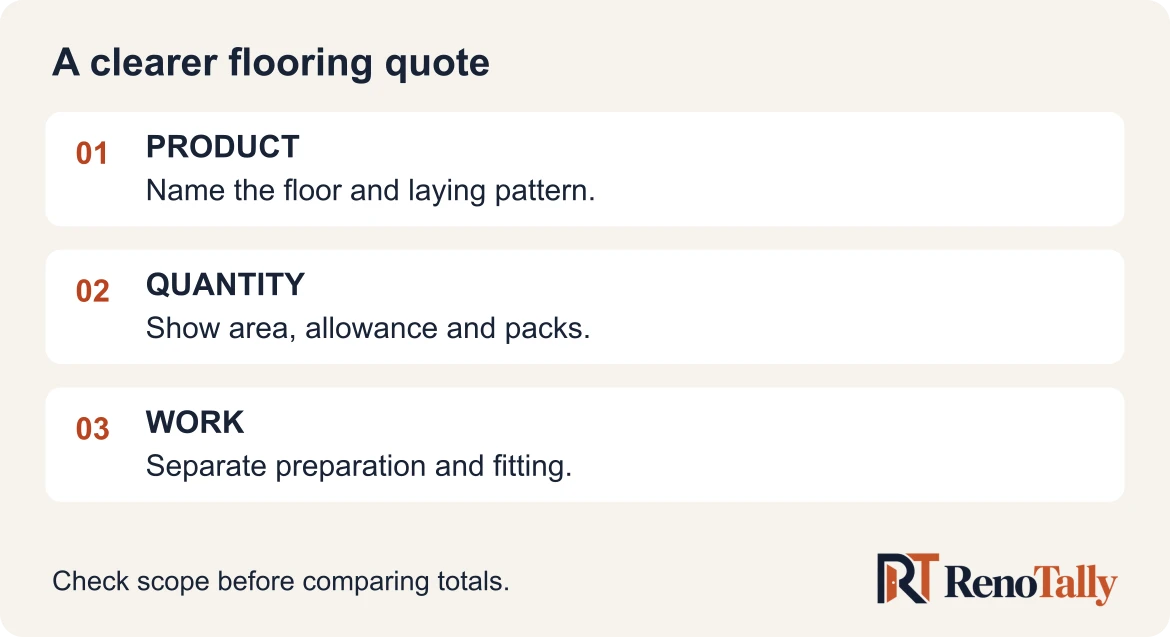
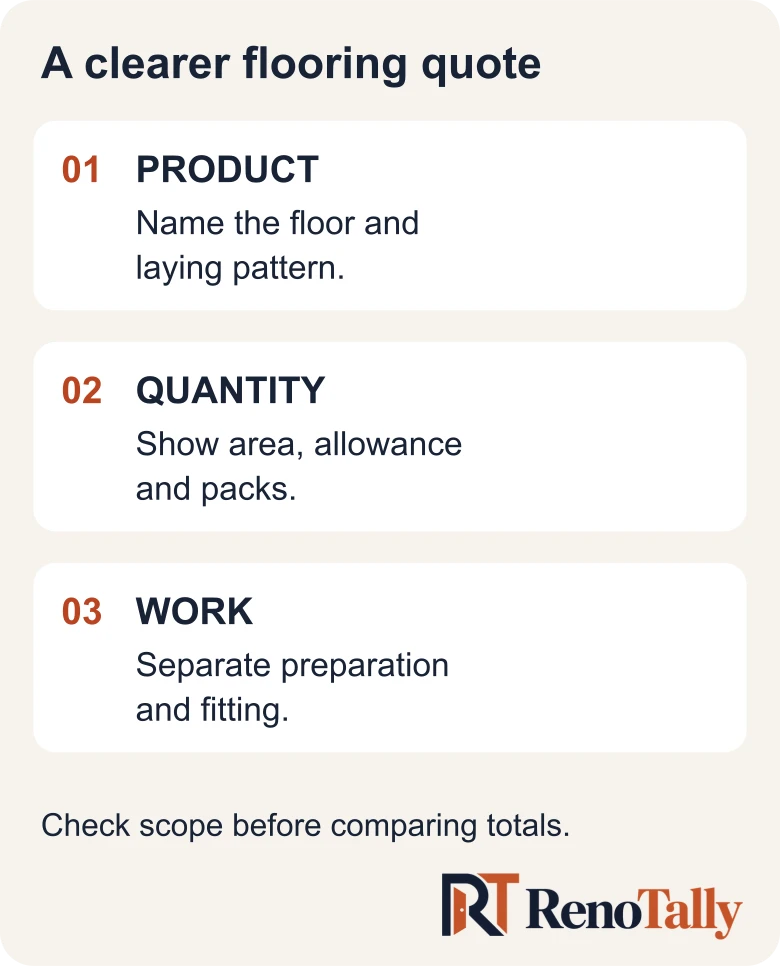
Define the product
Name the floor, pack coverage and installation pattern.
Separate the work
Show preparation, materials and fitting individually.
Compare the scope
Check exclusions and VAT before comparing totals.
In this guide
What should a flooring quote include?
Start with the room and the product, not just a price per square metre. Record which rooms or areas are covered, the chosen flooring specification, the intended layout and who is responsible for ordering. A laminate plank, an engineered board and a vinyl product are not interchangeable specifications.
A useful quote makes the basis of its quantity clear: measured floor area, an agreed cutting allowance and the quantity actually purchased. It also separates supply from installation. That lets a homeowner compare like with like, and gives a flooring professional a clearer record of the agreed work.
Worked example: record the area being priced
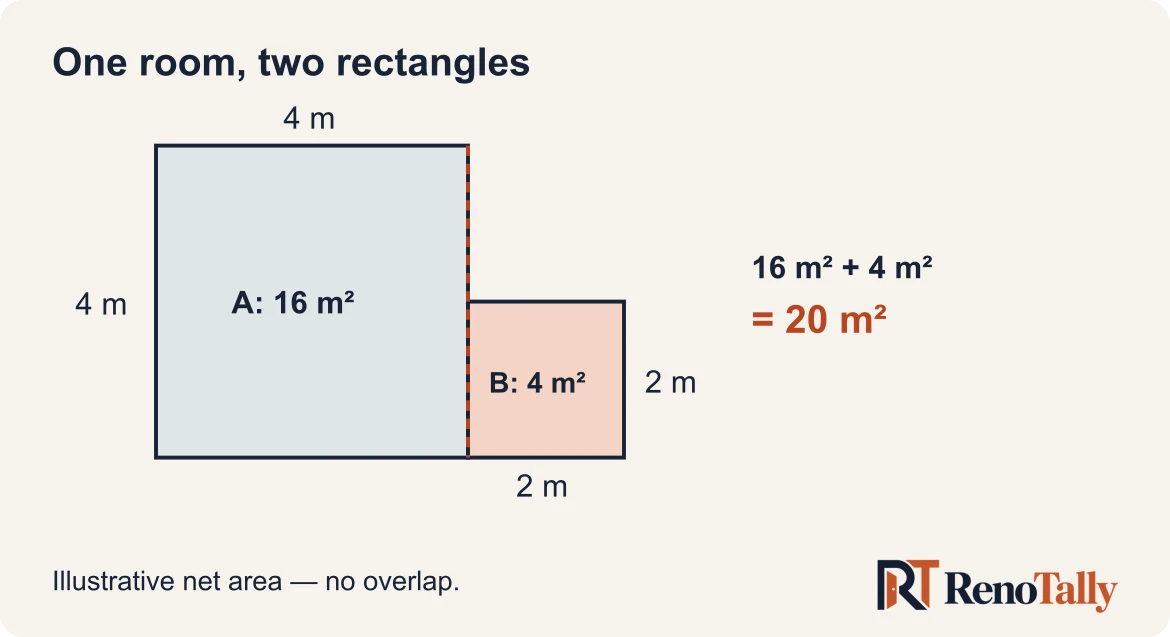
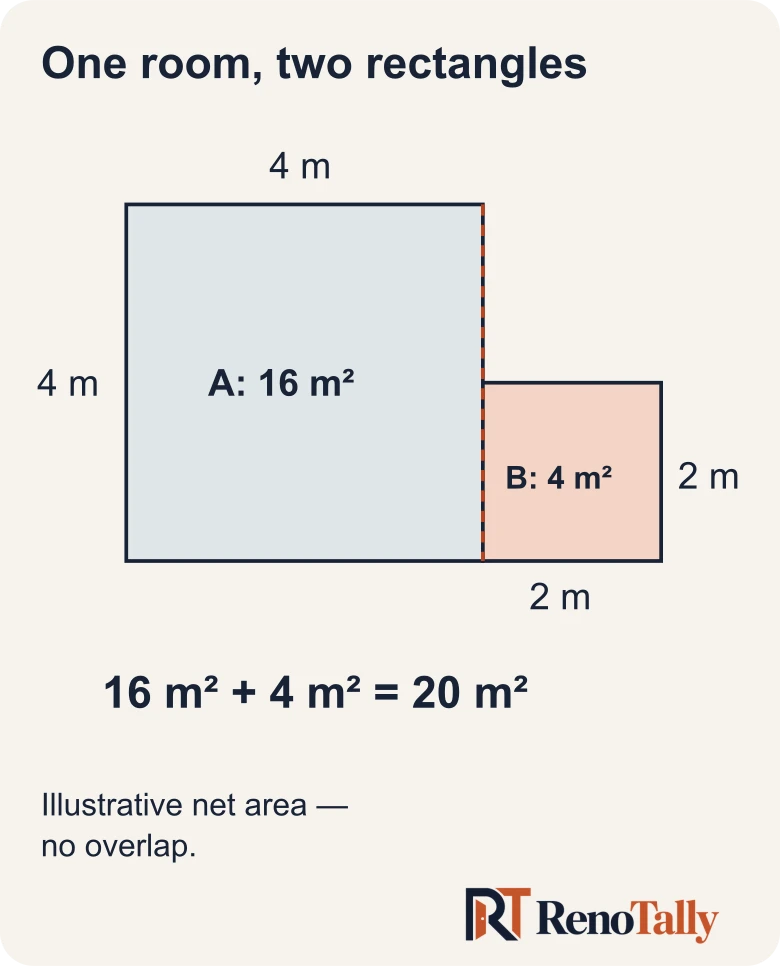
Imagine an L-shaped room with an overall footprint of 6 metres by 4 metres and a 2-by-2-metre corner missing. Split it into two non-overlapping rectangles: 4 × 4 = 16m² and 2 × 2 = 4m². The measured floor area is therefore 20m². Do not count the shared edge as extra floor area.
This is a static arithmetic example, not an output from our calculator. It explains the quantity entry in the quote; it does not establish a fitting price. For the full measuring process, use our flooring measurement and wastage guide.
Keep cutting allowance and pack rounding separate
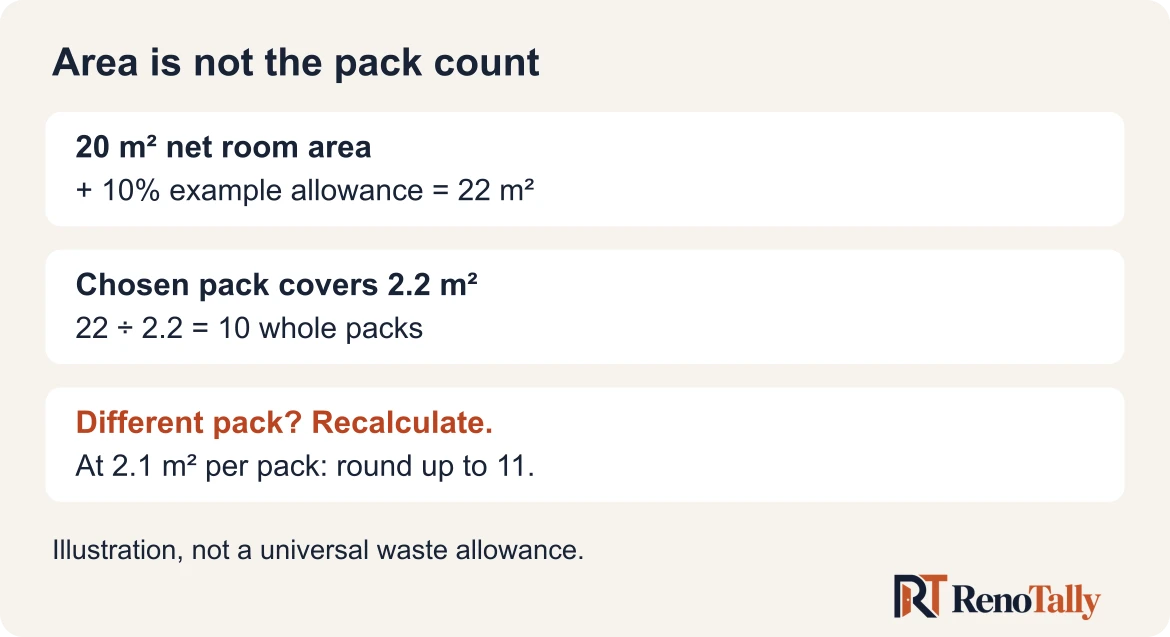
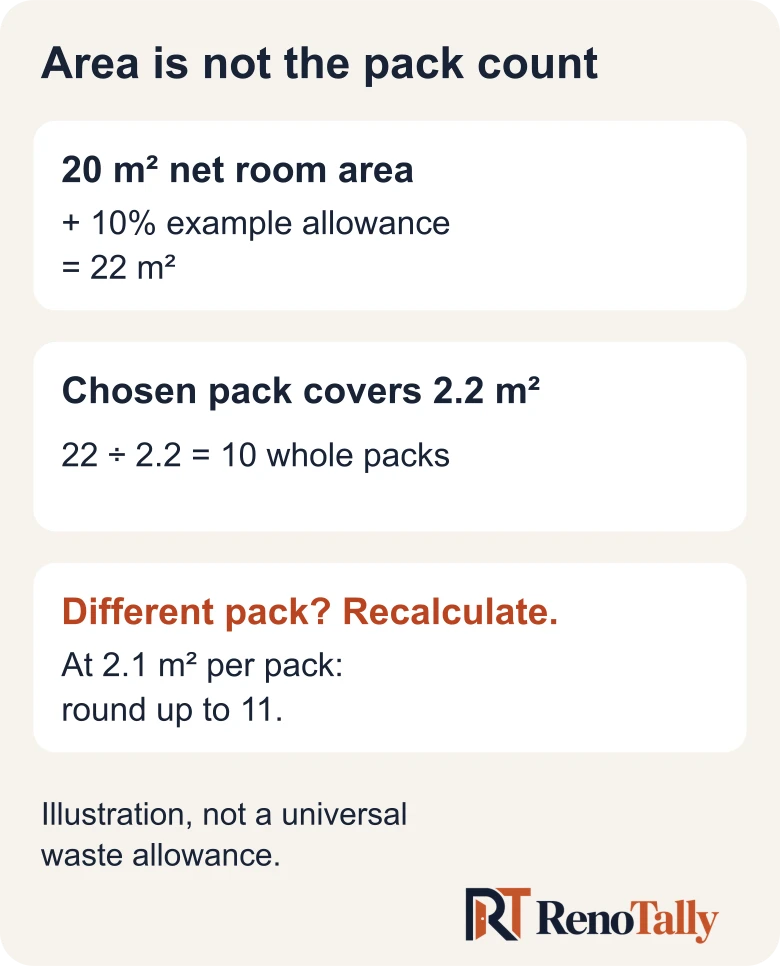
For illustration, adding 10% to the 20m² room gives a planned material quantity of 22m². Ten per cent is an example, not a rule for every product or pattern. Agree the allowance with the fitter or supplier, using the actual layout and manufacturer’s instructions.
If the chosen product covers 2.2m² per pack, 22 ÷ 2.2 = 10 whole packs. A different product covering 2.1m² per pack would require 11 packs: 22 ÷ 2.1 is about 10.48, rounded up. Those 11 packs cover 23.1m². The extra 1.1m² comes from buying whole packs; it is not another percentage to add automatically.
Write down the actual coverage printed on the chosen product. Include any separately agreed spare material explicitly rather than hiding it in a second waste allowance. Check the supplier’s ordering and returns terms before assuming unopened packs can be returned.
Separate materials, preparation and fitting
A single total can hide important differences. List floor-covering supply separately from underlay or other specified layers, installation labour, trims and finishing. If removal of the existing floor, furniture movement or disposal is included, describe it. If it is not included, say so.
Preparation needs a clear allowance too. Record what has been inspected and what is included for the existing base. Do not assume a photograph proves that the floor is ready for installation. If levelling, repairs or moisture-related work cannot be confirmed until inspection or removal, identify that uncertainty and explain how a revised scope will be agreed.
Underlay, adhesive, accessories and preparation depend on the chosen product and installation system. This checklist is not an instruction to use every item on every job. Confirm compatibility and installation requirements before pricing them. Our flooring supply and fitting cost guide provides broader budget context; a project quote must still reflect its actual specification.
A flooring quote outline you can copy
Replace each prompt with the actual job details. This is a structure for your own document, not a ready-issued quote.
- Reference and date: [quote number; preparation date; validity period]
- Project: [customer; site; rooms and boundaries included]
- Product: [manufacturer; range; finish; dimensions; pack coverage; laying pattern]
- Measured area: [room-by-room net area and measurement basis]
- Ordering quantity: [cutting allowance; whole packs; purchased coverage; agreed spares]
- Supply responsibility: [who orders; delivery; storage; checks on arrival]
- Preparation: [inspection basis; removal; repairs; levelling; agreed limits]
- Installation: [fitting scope; specified layers or adhesive; cuts; trims; thresholds]
- Access and finishing: [furniture; protection; doors; waste removal; completion tasks]
- Price breakdown: [quantities; units; rates; line totals; subtotal; VAT treatment; total]
- Programme and payment: [proposed dates; dependencies; payment stages agreed for this job]
- Exclusions and changes: [items outside scope; provisional items; how changes will be documented and agreed]
Use your own appropriate business terms. Do not assume this checklist creates a binding agreement or resolves the legal distinction between a quotation and an estimate.
How to compare two flooring quotes
Check the product and scope first, then the price. Are both proposals for the same floor, pattern and rooms? Does one include supply while the other assumes the customer will buy the material? Are delivery, trims and disposal included in both? If these differ, the headline totals are not directly comparable.
Ask for VAT treatment to be stated clearly. Do not add or deduct VAT simply because two totals look different. Also separate an allowance for uncertain work from a confirmed line item. A contingency in your own budget is not automatically part of the contractor’s agreed price.
Before accepting, clarify inspection assumptions, exclusions, timing and how changes will be agreed. Keep a copy of the scope you compared. If a detail changes, update the comparison rather than relying on the original headline total.
Use a planning estimate before requesting a quote
Our calculator helps organise a flooring budget using the inputs you provide. Its modelled estimate is not a supplier quotation, a site survey or a guarantee of the eventual price. Use it as a planning starting point, then ask professionals to quote against a clear specification.
Try Our Flooring Calculator for your project. Check the estimate’s assumptions and breakdown rather than treating the material quantity as the complete installed cost.
Professionals can find relevant planning tools on our flooring and tiling resources page. If you are considering joining RenoTally, read the current contractor membership information; using this checklist does not create a membership or promise enquiries.
Common flooring quote questions
Should the fitting area equal the purchased material area? Not necessarily. Whole packs and a cutting allowance can increase the purchased quantity beyond the net room area. Ask which quantity and unit each line uses; do not assume the supply and labour bases must be identical.
Can I compare a supply-only quote with a supply-and-fit quote? Only after identifying the missing work and obtaining the relevant prices. Do not assume preparation or fitting is included because the quote says ‘flooring’.
Is 10% waste always enough? No universal allowance is established here. Product dimensions, room shape and pattern affect cutting. The figure in the worked example is illustrative; agree a suitable allowance for the actual job.
Does the cheapest total mean the best value? A total alone cannot show that. Compare the product, included work, exclusions and assumptions, then decide whether the proposals meet your requirements.
Sources and methodology
The diagrams and arithmetic examples were prepared for RenoTally and checked on 19 October 2026. They illustrate area, an assumed cutting allowance and whole-pack rounding; they are not market-survey prices or a new calculator calibration. No material, labour or VAT rate is assumed in the worked example.
Read our sources, methodology and estimate limitations. Product-specific instructions, pack coverage and the actual site conditions take precedence over this simplified planning example.