
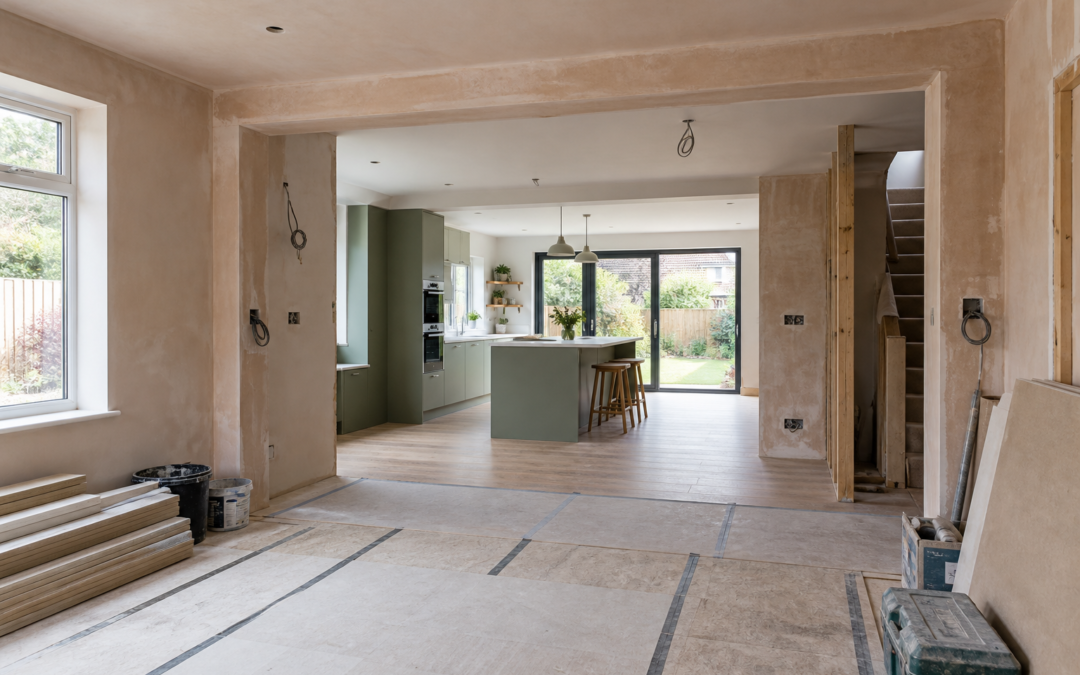
How much does it cost to renovate or refurbish a house in the UK? The honest answer depends less on the number of bedrooms than on the condition of the building and the work actually included. A cosmetic refresh, a full services upgrade and a back-to-brick project are not comparable jobs—even when the houses have the same floor area.
For early 2026 planning, allow roughly £400–£800 per m² for a cosmetic refresh, £900–£1,600 per m² for a moderate renovation, £1,200–£2,500 per m² for a full refurbishment, and potentially £1,800–£3,500+ per m² for a back-to-brick or unusually complex project. These are broad planning bands, not quotations. Location, specification, VAT, professional fees and hidden defects can move the total significantly.
Price the work you actually plan to do
Use the free whole-house calculators for a regional, itemised planning range.
Renovation vs refurbishment: what is the difference?
The two words are often used interchangeably, but on RenoTally we treat them as different scopes of work. Renovation typically means updating, repairing or modernising what’s already there — a new kitchen, bathroom, décor, flooring or an extra room. Refurbishment usually goes further, covering deeper work such as rewiring, replumbing, structural alterations or a full strip-back-to-brick renewal of the property.
There is no universal industry dividing line, and contractors, lenders, estate agents and homeowners may use the terms differently. That is why a useful estimate should list the scope rather than rely on the project label. “Full refurbishment” should be translated into specific work packages before anyone compares prices — which is why RenoTally has two dedicated calculators: one for lighter renovation work, and one for full refurbishment and back-to-brick projects.
House renovation and refurbishment cost per square metre
Published UK price guides vary considerably because they include different work, quality levels, VAT assumptions and professional fees. The ranges below are deliberately broad starting points for a whole-property project.
| Project level | Early planning band | Typical scope |
|---|---|---|
| Cosmetic refresh | About £400–£800/m² | Decoration, minor repairs, selected flooring and limited replacements |
| Moderate renovation | About £900–£1,600/m² | Kitchen and bathroom work, flooring, plaster repairs and some service upgrades |
| Full refurbishment | About £1,200–£2,500/m² | Extensive strip-out, kitchen, bathrooms, rewiring, plumbing, heating, plastering and finishes |
| Back to brick / complex | About £1,800–£3,500+/m² | Heavy strip-out, new services, structural alterations and substantial rebuilding |
Do not multiply the highest figure by the floor area and assume every item is covered. Extensions, loft conversions, external works, asbestos remediation, serious damp, temporary accommodation and professional fees may sit outside a general refurbishment rate.
Why online renovation estimates disagree
A cost-per-square-metre figure compresses dozens of decisions into one number. One guide may describe a “full renovation” as a new kitchen, bathroom and decoration. Another may include a complete rewire, replumb, windows, structural work and premium finishes. Current UK guides consequently publish very different ranges. The safest response is to treat a per-m² figure as a sense check and build the working budget from an itemised scope.
What changes the cost of refurbishing a house?
- Existing condition: hidden damp, rotten timber, unsafe wiring and failing drainage can only be understood properly after investigation.
- Location: labour, access, parking, waste handling and contractor availability differ by region. London and parts of the South East generally carry higher allowances.
- Property age: older homes can need breathable materials, specialist repairs or more careful work around the existing fabric.
- Kitchens and bathrooms: these rooms contain expensive fittings and several trades, so quantity and specification matter more than bedroom count.
- Services: rewiring, heating and plumbing upgrades affect walls, floors and the project sequence as well as the direct trade cost.
- Structural changes: removing walls, forming openings and installing steels introduce design, approvals and uncertainty.
- Finish level: cabinetry, worktops, sanitaryware, tiles, flooring and architectural joinery can change the budget dramatically.
- Occupied work: protecting belongings, maintaining services and working around occupants can slow the programme.
Worked example: renovating a 90m² house
90m² semi-detached house in the Midlands
Moderate renovation
One kitchen and one bathroom
Electrical, plumbing/heating and flooring allowances
Good-standard finish
20% VAT and 15% contingency included
Using those assumptions, the RenoTally calculator currently produces an expected working range of approximately £100,800–£117,100.
This does not mean every 90m² house should cost that amount. Unticking service upgrades, choosing budget finishes or retaining the kitchen changes the total. An older property, difficult access, London location or additional structural work moves it the other way.
For the most useful comparison, refine the biggest components separately with the Kitchen Calculator, Bathroom Calculator and Flooring Calculator.
VAT, contingency and costs people forget
Check whether VAT is included
Most renovation work by VAT-registered builders is normally charged at the standard rate. Some qualifying work may receive different treatment. HMRC states that certain renovations of eligible residential property that has been empty for the two years immediately before work starts may qualify for a reduced 5% rate, subject to detailed conditions. Do not assume the reduced rate applies: ask the contractor to confirm their VAT status and the treatment of each part of the work in writing.
Keep contingency separate
A contingency is not an optional upgrade budget. It is protection against information that was unavailable when the estimate was prepared. Ten per cent may be a starting point for a well-investigated, straightforward project; 15% is more cautious for typical refurbishment planning; and 20% or more may be sensible for older, empty or poorly understood buildings.
Common exclusions
- Architect, structural engineer, surveyor and party wall fees
- Planning applications, building control and specialist reports
- Temporary accommodation, storage and removals
- Asbestos testing or removal
- Unexpected damp, drainage, roof or structural repairs
- Garden, driveway and boundary work
- Loose furniture, blinds and styling
See VAT and contingency separately
The calculators show the selected work packages before adding VAT and contingency.
Before asking contractors for refurbishment quotes
- Write down what is staying, what is being repaired and what is being replaced.
- Measure the property and count kitchens, bathrooms, windows and significant openings.
- Arrange appropriate surveys before fixing the budget for a poor-condition purchase.
- Check whether planning permission, building regulations or other approvals apply.
- State the expected finish level and identify any products already chosen.
- Ask every company to price the same scope and show VAT, exclusions and provisional sums.
- Keep the contingency outside the contractor’s quoted total.
The Planning Portal is a useful starting point for England and Wales, but requirements depend on the work and location. Confirm matters with the relevant local authority and qualified advisers before construction begins.
Frequently asked questions
How much does it cost to completely renovate a house?
A complete UK renovation can range from roughly £1,200 to £3,500+ per square metre depending on whether “complete” means a standard full refurbishment or a back-to-brick project with structural changes. Define the work packages before relying on the rate.
Is refurbishment cheaper than renovation?
Often, but not automatically. A light refurbishment is normally cheaper than a structural renovation. However, the words are used inconsistently, so the included work is more important than the label.
How much contingency should I allow?
For early planning, 10–15% is common, while an older or poorly understood property may justify 20% or more. The appropriate figure depends on surveys, design progress and how many items remain uncertain.
Does the calculator include extensions and loft conversions?
No. Treat them as separate projects and use the Loft Conversion & Extension Calculator, then combine the budgets carefully without double-counting shared work.
Read our project-specific guides
Working on a particular room or project? These guides break down costs in more detail:
- Kitchen Renovation Cost UK: 2026 Price Guide
- Bathroom Renovation Cost UK: 2026 Guide & Calculator
- Loft Conversion Cost Per m² in the UK: 2026 Price Guide
- Flooring Cost UK 2026: Supply and Fitting Prices per m²
- How Much Flooring Do I Need? UK Room Calculator & Wastage Guide
- Small Ensuite Retiling Cost UK: 2026 Price Guide
Build your renovation or refurbishment budget
Start with the free House Renovation Cost Calculator for cosmetic or moderate work, or the House Refurbishment Cost Calculator for full refurbishment and back-to-brick projects. Both provide low, expected and upper ranges, an itemised breakdown, a regional adjustment, VAT choice, contingency and a broad programme band. For an explanation of the limitations, read How Our Estimates Work.
Sources and methodology: The planning bands have been sense-checked against current UK guides from Checkatrade and Chat to Your Builder. VAT wording is based on HMRC VAT Notice 708. Prices are broad planning allowances, not quotations, and should be checked against a measured scope and local written quotes.